


This essay is drawn from published discussion. It cites classical Chinese books, the words of others, or academic argument, and is meant as cultural reading on the traditional cultivation of life. What it says about the body, and about what practice may do, belongs to the sources quoted or to the original speaker. It is not a medical promise or clinical advice from the people who operate this website.
Editor-in-chief Hu Xiaofei; text by Peng Xiangji and Li Jing.
First Frost is the last solar term of autumn. An old poem says, “When autumn grows late, the dew turns to frost.” Yueling Qishi’er Hou Jijie (Collected Explanations of the Seventy-Two Pentads of the Monthly Ordinances) says: “In the middle of the ninth month, the qi is austere and congeals; the dew freezes into frost.” The climate grows gradually colder; early frost begins. By then the Yellow River basin already shows white frost, and the fields are a sheet of silver.
The classical Ershisi Jieqi Jie (Explanations of the Twenty-Four Solar Terms) says: “The qi is austere and frost descends; yin begins to congeal.” In meteorology, the first frost of autumn is called early frost or first frost; the last frost of spring is called late frost or final frost.
Four Reminders at First Frost
- In diet there is the saying “supplementing at First Frost is better than supplementing in winter.” Autumn supplementation is valued above winter’s. Chinese medicine also holds that First Frost calls for mild supplementation: keep the diet as plain as possible, and do not take too much salt.
- In daily life, keep warm; do not linger in bed in the morning. The folk saying goes, “First Frost is not yet cold; when First Frost comes, the weather changes.” The day-night temperature gap widens; add clothing. In the morning the bedroom holds a night’s exhaled turbid qi, which affects the respiratory tract, so one should not stay in bed; sleep early and rise early.
- Exercise should arrange movement and stillness well. First Frost often falls in the ninth lunar month, when lung metal is in command. Exercise should not tire one excessively, still less cause frequent heavy sweating, lest yang qi leak outward and yin fluids be consumed, weakening resistance.
- Emotion should be steady. After First Frost the grass yellows and leaves fall; people easily fall into melancholy. Keep the mindset and cultivate openness.
First Frost Sitting Practice
From Wu Zhichao and Hu Xiaofei, Daoyin Fitness Methods Explained.
- Circulation governs: the five qi of yangming.
- Season paired with: foot-taiyang bladder, cold water.
Sit upright. Stretch both hands to grasp the two feet; relax the limbs, straighten both legs, then draw the hands back. Do this five to seven times. Then click the teeth, circulate the breath, and swallow the fluids.
Indications listed in the original text: wind-damp bi entering the waist and feet; thighs that cannot bend; pain in the nape, back, waist, coccyx, inner thigh, knee, and hip; muscle wilting; swelling below; stool with pus and blood; distending pain in the lower abdomen; desire to urinate without being able to; visceral toxin; cold in the sinews; beriberi; chronic hemorrhoids; prolapsed anus.
Reaching the Feet to Firm the Kidneys
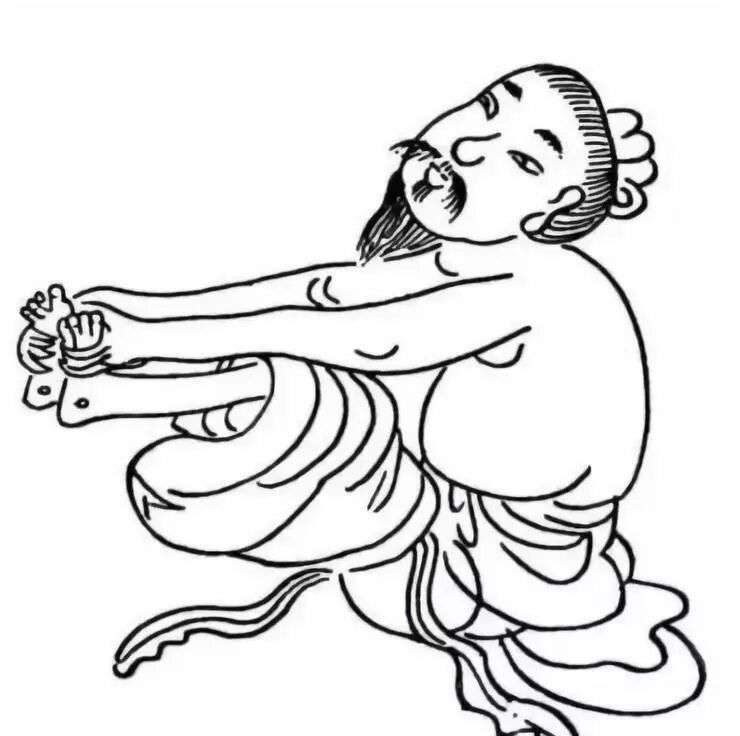
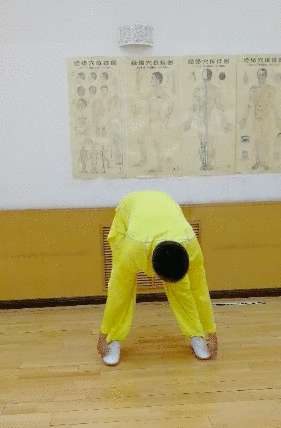
From Hu Xiaofei, Qianlong Yangsheng Shu (The Qianlong Emperor’s Methods of Cultivating Life). Demonstration by Peng Xiangji.
- On the inhalation, shift the center of gravity to the right leg, step the left foot left to shoulder width, toes forward. At the same time turn the head left; rotate both palms inward and prop them behind beside the hips, palms down, fingers forward, eyes looking to the left rear.
- On the exhalation, turn the head square; press Laogong (translator’s note: a point in the centre of the palm) of both palms on Shenshu (translator’s note: a point level with the kidneys, beside the lumbar spine). Then massage downward from the lower back along the outer-posterior sides of the legs, following the three yang meridians of the foot to the heels.
- On the inhalation, bend forward, hollow the waist, raise the head. Carry the heels of the palms forward, massage along the tops of the feet, then rotate the wrists and embrace the ankles. On the exhalation, press Taixi with the thumbs for three seconds, eyes looking forward and down.
- On the inhalation, straighten the body; massage upward along the inner sides of the legs on the three yin meridians of the foot to above the knees, eyes forward. On the exhalation, shift weight right, bring the left foot beside the right, open both palms outward and hang them at the sides, standing with feet together, eyes forward.
Movements five through eight are the same as one through four, in the opposite direction. Do six to eight rounds in all.
Key points:
- Force issues from the waist; move slowly; stretch fully. When turning the head, the peripheral vision of both eyes should also take in Jianyu.
- When bending forward, keep both legs straight; do not bend the knees. Raise the head.
- Intention at Mingmen (translator’s note: a point on the lower back, under the second lumbar vertebra), or at Taixi.
- The breath is leisurely, even, fine, and slow. On exhalation one may lightly utter the sound Chui.
Principles as stated in the original:
The three yang meridians of the foot are the foot-yangming stomach, foot-taiyang bladder, and foot-shaoyang gallbladder meridians, distributed on the outer and posterior sides of the legs. The three yin meridians of the foot are the foot-taiyin spleen, foot-shaoyin kidney, and foot-jueyin liver meridians, distributed on the inner sides of the legs. Massaging the outer and inner sides of the legs when bending and rising opens the three yin and three yang of the foot—that is, massage of these six meridians.
The waist is the mansion of the kidneys. The kidneys lie on either side of the spine at the waist; the strength of the waist is linked to the fullness or decline of kidney qi. Forward flexion and backward extension can both strengthen the muscle groups of the waist and stimulate Du Mai and Mingmen. The original text says this form has the effects of strengthening the waist and kidneys, enhancing the lumbar kidneys, and preventing aging.
Chinese medicine holds that the sound Chui corresponds to the kidneys. Uttering “Chui” is described as able to discharge turbid qi from the kidneys and regulate them. Added to the old saying “lengthen the sinews by an inch, add ten years to life,” the original text holds that practitioners may thereby gain flexibility and reach extended years.
Divine Dragon Raises Its Head While Walking
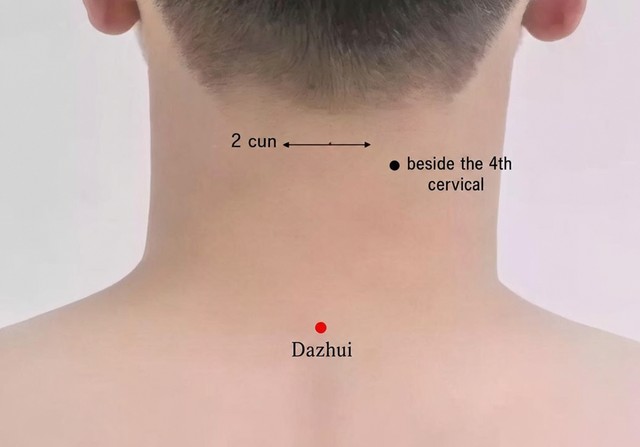
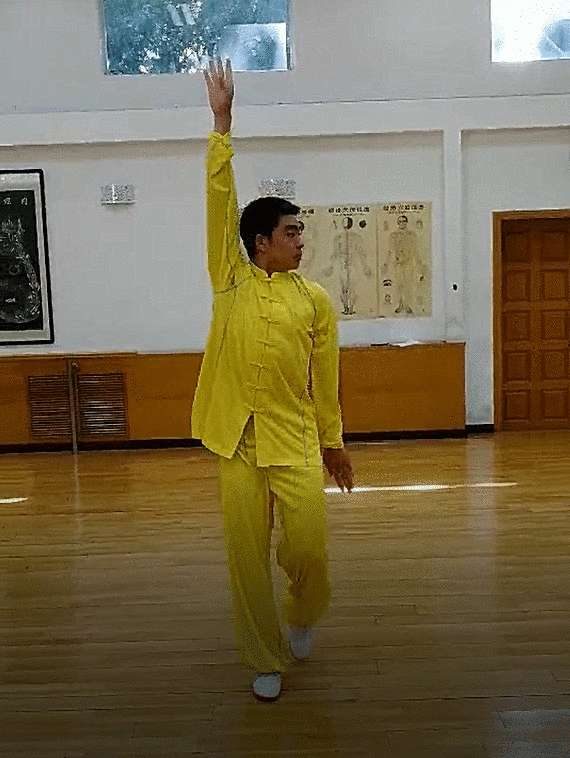
From Hu Xiaofei, Warm-Up Before Practice in Physical Cultivation.
- Walk naturally forward. Raise both palms before the chest, then rotate the wrists and thread the palms while lifting the head to look upward.
- Keep walking. Curl both palms into fists from the little finger on, pull downward, and draw them to the chest, eyes forward.
- Keep walking. Change both fists to palms, rotate inward, and thread one up and one down (right hand up, left hand down); turn the head to look left.
- Keep walking. Curl both palms into fists from the little finger on again, draw them to the chest, eyes forward.
Movements five and six are the same as one and two; seven and eight the same as three and four, in the opposite direction. Repeat one through eight, six to eight rounds in all.
Key points: while walking, keep the body centered and upright, the steps natural. When curling the fingers into fists while advancing, proceed in order from little finger to thumb.
Effects as stated in the original: curling the fingers and making fists help stimulate the nerve endings at the fingertips, improve peripheral microcirculation, and are described as helpful in preventing Alzheimer’s disease in middle and old age. Raising and turning the head while walking helps stimulate Dazhui on Du Mai (below the spinous process of the seventh cervical vertebra), achieving benefit to qi and opening of yang, moistening the lungs and clearing dryness. Twisting the forearms helps stimulate the three yin and three yang meridians of the hand, thereby opening heart and lungs. The original text says it may be used to prevent and treat colds and coughs common at First Frost.
At First Frost one may practice the following six forms standing: Dry Bathing Yingxiang, Rubbing the Abdomen to Guide Ren Mai, Percussing the Back to Open Du Mai, Rotating the Heavenly Pillar, Divine Deer Stretches Its Body, and Reaching the Feet to Firm the Kidneys. For walking, four forms may be paired: Rubbing the Abdomen to Guide Ren Mai, Percussing the Back to Open Du Mai, Rotating the Heavenly Pillar, and Divine Dragon Raises Its Head.