

This essay is drawn from published discussion. It cites classical Chinese books, the words of others, or academic argument, and is meant as cultural reading on the traditional cultivation of life. What it says about the body, and about what practice may do, belongs to the sources quoted or to the original speaker. It is not a medical promise or clinical advice from the people who operate this website.
Editor-in-chief Hu Xiaofei; text by Peng Xiangji.
The Autumn Equinox is the sixteenth of the twenty-four solar terms. On this day day and night are equal, and autumn itself is divided in half. Only at the Autumn Equinox does the south formally enter autumn; thereafter each night grows cooler than the last. This day has twelve hours of day and twelve of night; nowhere on earth has polar day or polar night.
Of old there was “in spring sacrifice to the sun, in autumn sacrifice to the moon.” The Autumn Equinox was once the traditional festival of moon sacrifice; the later Mid-Autumn Festival grew from that moon sacrifice.
The Three Pentads of the Autumn Equinox
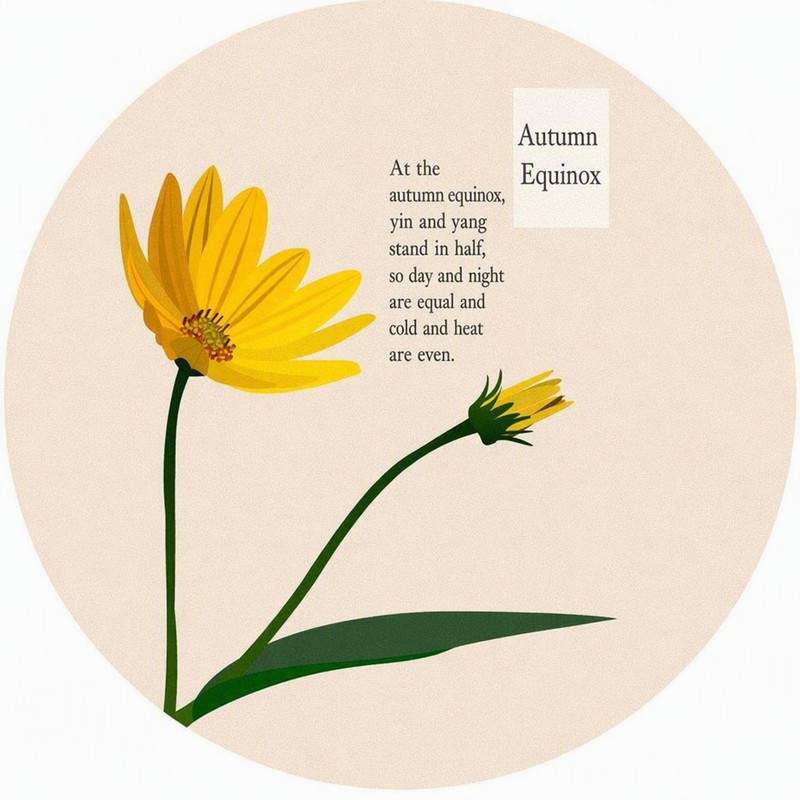
The ancients divided the Autumn Equinox into three pentads, five days each: “First pentad, thunder begins to fall silent; second pentad, dormant insects seal their burrows; third pentad, the waters begin to dry.”
Thunder begins to fall silent. The ancients held that thunder sounds when yang qi is abundant. After the Autumn Equinox yin qi turns abundant, and thunder ceases.
Dormant insects seal their burrows. “Seal” here is fine earth. As the weather turns cold, small insects that hide away go into their holes and close the mouths with fine earth, so that cold qi cannot enter.
The waters begin to dry. Rainfall lessens, the air grows dry, moisture evaporates quickly, lakes and rivers hold less water, and marshes and puddles gradually dry up.
After the three pentads, those with yin deficiency easily feel unwell. At the Autumn Equinox it is fitting to hold the sense of nourishing yin, lest cold qi enter the body.
Four Things to Remember at the Autumn Equinox
- Around the Autumn Equinox, cultivation of life rests on the balance of yin and yang. Before the equinox, residual summer heat remains, and warm dryness is common; after it, autumn winds come in waves, cold and coolness grow heavier, and cool dryness is common. To guard against cool dryness, keep up Daoyin. Autumn exercise emphasizes enriching the lungs and moistening dryness.
- After the Autumn Equinox the temperature drops quickly; add clothing and guard against colds. Peng Xiangji recommends pairing Daoyin for the equinox: Rotating the Heavenly Pillar while walking, and Divine Deer Stretches Its Body while standing, to strengthen the constitution.
- Diet should keep yin and yang secret and at peace; avoid acrid spice and greasy food; take more clear-moistening and warm-moistening foods, seeking to nourish yin, moisten the lungs, and generate fluids.
- Mood should be optimistic, the spirit at rest; avoid the killing breath of autumn, gather the spirit-qi inward, and adapt to autumn’s even, accommodating qi.
Autumn Equinox Sitting Practice
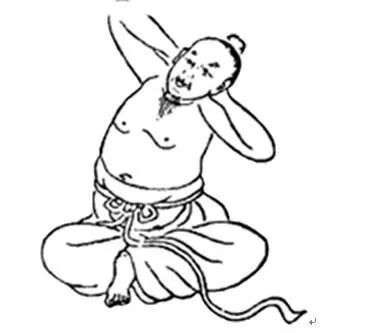
From Wu Zhichao and Hu Xiaofei, Daoyin Fitness Methods Explained.
- Circulation: governs the five qi of yangming.
- Season: paired with the foot-yangming stomach and dry metal.
Sit with the legs crossed. Cover the ears with both hands and turn the head left and right, three to five times each. Then click the teeth, circulate the breath, and swallow the saliva.
Indications listed in the original text: accumulation of wind-damp; abdominal distension with edema; swelling and pain of the knees and kneecaps; qi rushing to the chest and breasts; pain on the outer side of the thighs and shins; enuresis; abdominal fullness; rapid digestion with much drinking; stomach cold with wheezing and fullness.
Divine Deer Stretches Its Body
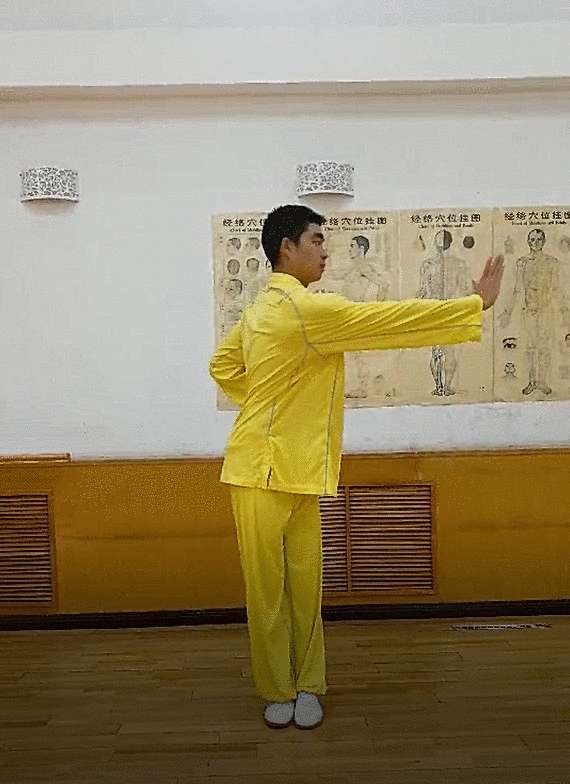
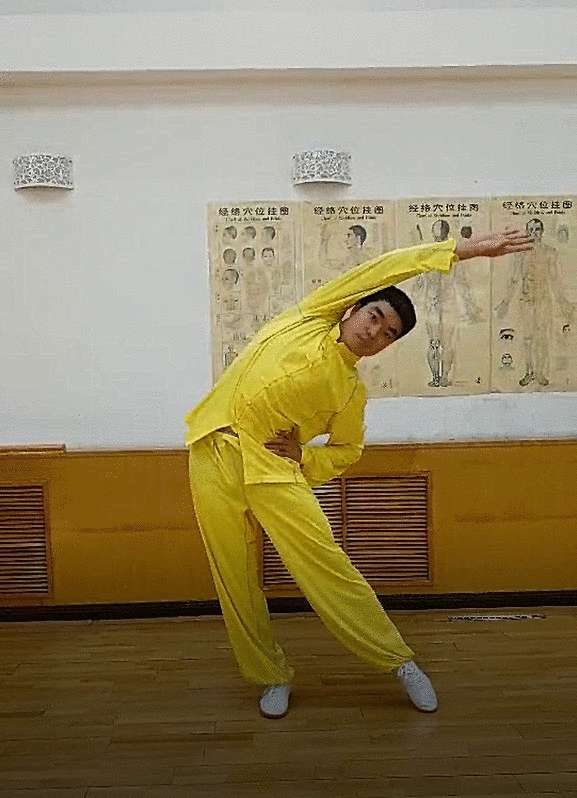
From Hu Xiaofei, Warm-Up Before Practice in Physical Cultivation. Demonstration by Peng Xiangji.
Preparation: both hands in fists at the waist.
- On the inhalation, turn the body ninety degrees to the left; at the same time change the right fist to a palm and push it leftward, fingers pointing up, eyes on the right palm.
- On the exhalation, turn the body square again, draw the right palm back to the waist, push the left palm leftward, eyes on the left palm.
- On the inhalation, step the left foot out, place the left hand on the waist, and drill the right hand upward and leftward in a spiral. Center of gravity on the right leg, eyes forward.
- On the exhalation, return the body to square, bring the left foot together, place both fists at the waist, eyes forward.
Counts five through eight are the same as one through four, in the opposite direction. Do two sets of eight counts each time.
Key points:
- When the right palm pushes left, the left fist stays at the waist without moving; the left elbow intentionally draws toward the right. When doing it to the right, the method is the same, direction reversed.
- When the body leans and stretches to the side, the trunk tilts in the coronal plane and Dabao is pressed upward with force.
- Place the intention on stretching and lengthening the body.
Effects as stated in the original: when pushing the palm, the fingers draw back and the heel of the palm presses forward, which helps stimulate the hand-taiyin lung meridian and moistens the lungs while clearing dryness. Turning and stretching the trunk help increase flexibility, and are described as able to strengthen sinews and bones and extend the years.
Rotating the Heavenly Pillar While Walking
From Zhang Guangde, Yiqi Yangfei Gong (Practice for Benefiting Qi and Nourishing the Lungs).
- Walk naturally forward. As you walk, rotate the arms inward and open them outward; when they reach shoulder height, curl the fingers in sequence.
- Bring the right foot alongside, bend both legs slightly, turn the body left, look behind, and at the same time massage and guide with both hands along the bladder meridian on the back.
- Same as the first movement.
- Same as the second, but turn the body to the right.
Repeat movements one through four, eight times in all.
Key points: while walking, keep the body centered and upright, the steps natural. Curling the fingers while advancing, and rubbing the back when the feet come together and you squat, should form one continuous flow; upper and lower limbs coordinate.
Effects as stated in the original: curling the fingers helps stimulate the nerve endings at the fingertips, improves peripheral microcirculation, and is described as helpful in preventing Alzheimer’s disease in middle and old age. Pausing while walking to turn the body and rub the back helps ease tension in the back muscles, prevent and treat lumbar muscle strain, promote circulation in the back, lift the spirit, and clear fatigue.
At the Autumn Equinox one may also combine Dry Bathing Yingxiang, Rubbing the Abdomen to Guide Ren Mai, Percussing the Back to Open Du Mai, and the movements above as practice for this solar term.