
This essay is drawn from published discussion. It cites classical Chinese books, the words of others, or academic argument, and is meant as cultural reading on the traditional cultivation of life. What it says about the body, and about what practice may do, belongs to the sources quoted or to the original speaker. It is not a medical promise or clinical advice from the people who operate this website.
Main speaker Hu Xiaofei, assistant Zhuang Yongchang. The six forms below belong to Warm-Up Before Practice. They are used, before entering a full set of exercises, to loosen the joints, settle the breath, and gather the mind inward.
Opening Practice with the Three Regulations
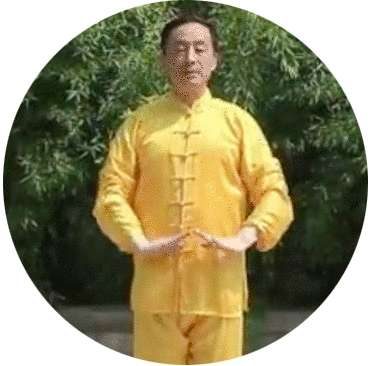
Opening practice opens the gate before training. The three regulations are regulating form, regulating the breath, and regulating the spirit.
Daoyan Qianjin says: “When the mind rests below the navel, that is concentrating the spirit; when qi returns below the navel, that is regulating the breath. When spirit and breath rely on each other, and one guards their clear stillness and naturalness, that is ‘do not forget’; when one follows their clear purity and naturalness, that is ‘do not force.’” This form seeks unity of intention, deep and long breathing, and a body light as a swallow, through intention at the Dantian, abdominal breathing, and an upright, centered body. First bring the three regulations into one, then enter the practice that follows.
Verse:
Set all affairs aside, rest lightly as on a lotus; the mind still as a pool, the body like a swallow;
sun and moon hang in the void, circulate Ren Mai and Du Mai; without dream of Penglai, let yourself soar.
What the verse asks for: set aside what is at hand, relax body and mind, even the breath, loosen the mood, and enter an unforced state.
Hu Xiaofei speaks of two sides to this form’s effect: relaxing the body, evening the breath, and quieting the mind; and easing mental tightness, improving blood circulation, and increasing intestinal and gastric motility.
Key points:
- Keep the body upright and the form loose. Sink the shoulders, lift the crown, and coordinate the upper and lower limbs.
- Let the eyelids hang like a curtain. The eyes regard the nose, the nose regards the heart, the heart settles in the Dantian, entering a state of deep reverence.
- Breathe evenly, gather the spirit inward, let joy arise from within, and place the intention on silently repeating the formula.
Hu Xiaofei reminds: those who work in offices may do three to five minutes of the bowing-to-Buddha posture in the intervals of the day. The place should be quiet and safe, so that practice is not broken by sudden interruptions.
Azure Dragon Raises Its Head
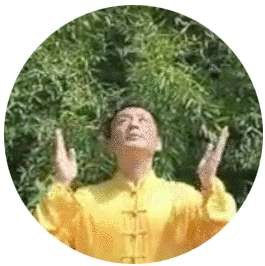
The dragon is a Chinese totem. The Azure Dragon is the spirit of the east. Raising the head means lifting the head, and also turning it.
This form takes “Azure Dragon Raises Its Head” as likeness: spring returns to the earth, the ten thousand things revive, heaven and earth answer each other, and the person stretches the waist, lifts the head upward, as if greeting the spring light. The aim is to mobilize the shoulders and neck, awaken the body, and lift the spirit.
Effects:
- Mobilize the neck and shoulder joints, stretch the upper limbs and trunk, and warm the whole body first.
- Benefit qi and open yang, soothe the liver and gallbladder, open the lungs and ease wheezing.
- Used to prevent the eye fatigue, wrist discomfort, tight shoulders, and neck-and-shoulder unease common in long sitting at a desk.
Key points:
- Turning the neck and raising the head should gradually increase in force. When raising the head, do not lean the upper body back; press the chin upward.
- Curl the fingers into fists in sequence, grip with strength, and let Zhongchong (translator’s note: a point at the tip of the middle finger) press into Laogong (translator’s note: a point in the centre of the palm).
- Move slowly, breathe long, use a large range, and place the intention at Dazhui (translator’s note: a point just below the seventh cervical vertebra).
Hu Xiaofei reminds: those who already have cervical disease, or whose hypertension is severe, should be careful with neck movements, or omit them. Office workers may do four sets of eight counts in the morning and afternoon intervals. When walking, one may move once every four steps, for eight to sixteen sets of eight counts.
Soaring Qilin Rolls the Waves
The auspicious qilin in the name is the qilin; rolling the waves is two qilin flipping up and down in the clouds. The ancients said, “The qilin is a beast of benevolence,” and held that wherever the qilin appears, there must be auspicious omen.
In this form, curling the fingers, cutting with the wrists, and bending the elbows stimulate the yuan-source points of the wrists and open the three yin and three yang meridians of the hand. The arms rotate and wind, the center of gravity shifts left and right, like qilin tumbling in the clouds. While practicing, one may borrow this image and let joy arise from within.
Effects:
- Mobilize elbows, wrists, and fingers, and warm the whole body first.
- Huangdi Neijing (The Yellow Emperor’s Inner Classic) says: “When the heart and lungs hold pathogen, their qi remains in the two elbows.” Hu Xiaofei takes this to say that this form can improve cardiovascular and respiratory function.
- Improve leg strength, raise balance, and help prevent osteoporosis.
Key points:
- The rotation of the arms, and the flexion and extension of elbows, wrists, and fingers, must all be done fully.
- Empty and full in the center of gravity must be clear. The range of squatting and rising should be large, the speed slow.
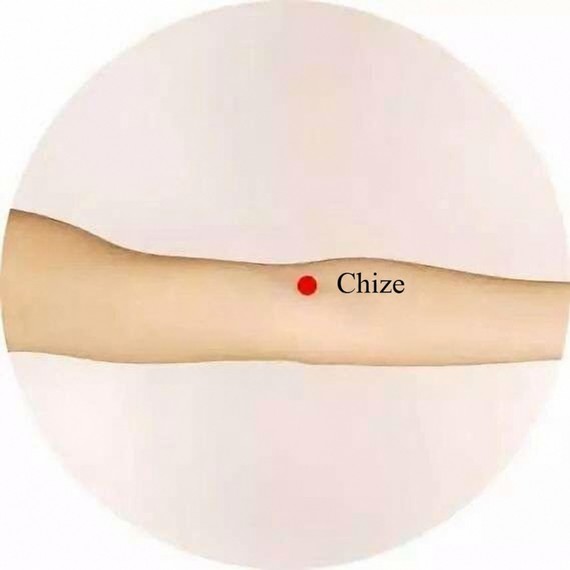
- Place the intention on the winding of the upper limbs, or at Chize.
Hu Xiaofei reminds: those who are older or physically weak should squat only as deep as strength allows. In summer, or for those with cardiovascular discomfort, this form is better practiced more while walking.
Fierce Tiger Stretches Its Body
The fierce tiger is king of the mountains. Stretching the body is the tiger opening its frame, as if about to spring from the hills.
This form is made as a continuous sequence of extending the knees, opening the hips, and expanding the chest; the body flexes, extends, and undulates section by section from below upward; then forward bending and pressing down mobilize the waist and knees. In form it is like the fierce tiger drawing in the waist and gathering force; it takes the tiger’s majesty to cultivate upright qi.
Effects:
- Stretch the muscles of the lower back and the backs of the thighs, and warm the whole body first.
- Mobilize the spine, open Ren Mai and Du Mai, firm the kidneys and strengthen the waist. Hu Xiaofei says this form is also used to improve reproductive and urinary function.
Key points:
- Force issues from the waist. When the knees straighten, the stretch must be full; movement and stillness alternate.
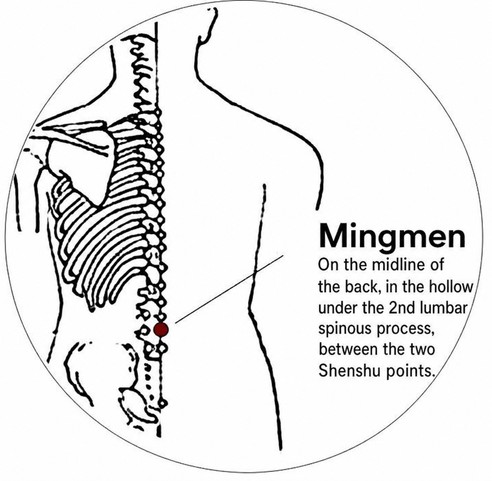
- Place the intention on stretching the back and the muscle groups on the backs of the thighs, or at Mingmen.
Hu Xiaofei reminds: those who are old and weak, or whose blood pressure is low, should practice according to their strength; this form calls for caution. In daily life one may do more stretching of the backs of the thighs.
Divine Turtle Draws in Qi
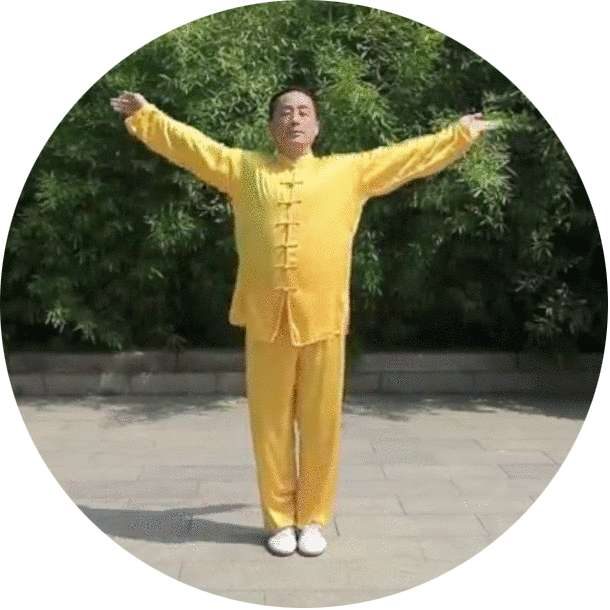
The divine turtle, also called the longevity turtle, takes auspiciousness and long life. Drawing in qi means gathering the essence of heaven and earth into the Dantian. The turtle is one of the four ancient spirits (dragon, phoenix, qilin, turtle); of the four, only the turtle remains in the world today.
This form uses lifting the heels while embracing upward and lowering the heels while guiding downward, together with deep, long abdominal breathing, to guide qi, gather qi, and store qi. Borrowing the image of the “ten-thousand-year divine turtle” is meant to build faith in lasting practice.
Effects:
- Mobilize ankles, toes, and shoulders, and stretch the upper limbs and trunk.
- Stimulate the jing-well and yuan-source points of the three yin and three yang meridians of the foot.
- Used to prevent falls and to deepen the breath.
Key points:
- Move soft and slow. The order of lifting the heels is: lift the crown, lift the hips, lift the anus and draw in the abdomen, then lift the heels. The order of lowering the heels is: sink the shoulders, loosen the abdomen, loosen the anus, then lower the heels.
- Before swinging the arms upward, first draw the scapulae inward, carrying the arms into external rotation.
- Action and breath unite; the breath is even and long. Intention is on guiding qi, gathering qi, and storing qi.
Hu Xiaofei reminds: in the intervals of daily life, one may rotate the ankles, and curl the toes to grip the ground then release them. Those who are old and weak may more often practice squatting and rising while holding onto something.
Breath Returns to the Origin
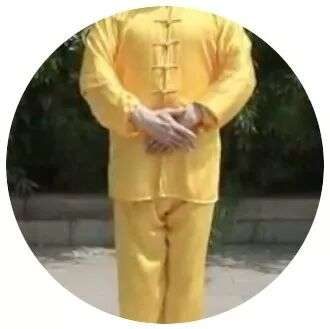
Breath here means the essence of heaven and earth outside the body, and also the true yuan within, and the qi of the zang-fu and of the four limbs and hundred bones. Returning to the origin comes from Daoist speech: going back to the original root, back to original qi; here it means concretely returning to the Dantian.
“Breath Returns to the Origin” is slowly gathering the qi within and without into the Dantian. Hu Xiaofei says its efficacy is to fortify the center and replenish the yuan, strengthen the body, open potential, and extend the years.
Effects: even the breath and gather the heart-spirit; fortify the center and replenish the yuan; and help prevent indigestion.
Key points:
- Keep the body centered and upright; movements coordinated and natural.
- Breathe deep and long. Relax the form; gather the spirit inward.
Hu Xiaofei reminds: those of weak constitution must not breathe hurriedly, nor use intention too forcefully. Those who find it hard to fall asleep, or who sleep restlessly, may do this six to nine times before sleep, using active practice to loosen body and mind. After vigorous activity, or when sudden urgency arises, one may lengthen the exhalation and at once do this form six to nine times, evening the breath and settling the spirit.