

This essay is drawn from published discussion. It cites classical Chinese books, the words of others, or academic argument, and is meant as cultural reading on the traditional cultivation of life. What it says about the body, and about what practice may do, belongs to the sources quoted or to the original speaker. It is not a medical promise or clinical advice from the people who operate this website.
Text: Hu Xiaofei and Zhang Jinru. Demonstration: Zhuang Yongchang.
“Illness has entered Gaohuang” means the disease is so severe that medicine cannot save it; it is also borrowed to say a matter is past retrieving. Gaohuang and Gaohuangshu (translator’s note: a point on the upper back, beside the spine) lie hidden; ordinary stretching of the arms and kicking of the legs rarely reach them. The movements below use “outer guidance and inner leading” to stimulate Gaohuang and Gaohuangshu.
Daoyin is described as able to benefit the joints, open the meridians, regulate qi and blood, strengthen the zang-fu, and quiet the heart-spirit. The effects gained in regulating Gaohuang come from intention, qi, and form acting together: hold intention at Gaohuang or Gaohuangshu; use slow, fine, even, long abdominal breathing to massage the nearby liver, spleen, stomach, and thymus; then use the limbs to set Gaohuang and Gaohuangshu in motion. The original text says that in this way one can promote blood circulation, promote the flow of qi and blood, and strengthen the function of the heart muscle and the diaphragm.
Do not practice the forms below within an hour after eating.
Vajra Rubbing the Ball
From Zhang Guangde, He Wei Jian Pi (Harmonizing the Stomach and Fortifying the Spleen). The full counts of this form appear in the essay on Daoyin Yangsheng Gong · He Wei Jian Pi Gong (Harmonizing the Stomach and Fortifying the Spleen). Here only its use in regulating Gaohuang is recorded.
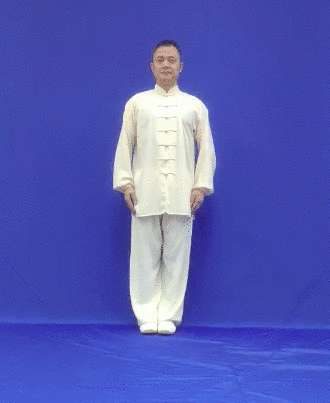
Preparation: stand with feet together.
- On the inhalation, step out; swing both arms to the sides.
- On the exhalation, make fists and thrust forward before the abdomen.
- On the inhalation, sink the left shoulder and raise the right.
- On the exhalation, sink the right shoulder and raise the left.
- Same as the third movement.
- Same as the fourth.
- On the inhalation, shift weight left; open both arms outward.
- On the exhalation, draw hands and feet back and restore the posture.
Key points: when rubbing the shoulders, fix the hips and knees; sink the shoulders and send them forward. The form is rubbing the shoulders; the reality is rubbing the abdomen; intention is at the Dantian.
Effects as stated in the original: stimulate Gaohuang and Gaohuangshu on the back; promote blood circulation in the liver, spleen, stomach, pancreas, and thymus; improve the function of the thoracic and abdominal organs and of immunity; fortify the center and replenish the yuan; extend the years.
Rubbing the Shoulders to Ease the Lungs (Standing)
From Hu Xiaofei, Qianlong Yangsheng Shu (The Qianlong Emperor’s Methods of Cultivating Life).
Preparation: stand with feet together.
- On the inhalation, step the left foot out; raise the right shoulder.
- On the exhalation, sink the right shoulder and send it forward; raise the left shoulder.
- On the inhalation, sink the left shoulder and send it forward; raise the right shoulder.
- Same as the second movement.
- Same as the third.
- Same as the second.
- Same as the third.
- On the exhalation, draw hands and feet back and restore the posture.
Key points, effects, and cautions are the same as for Vajra Rubbing the Ball above: fix the hips and knees, sink the shoulders and send them forward; the form is rubbing the shoulders, the reality rubbing the abdomen, intention at the Dantian.
Rubbing the Shoulders to Ease the Lungs (Sitting)
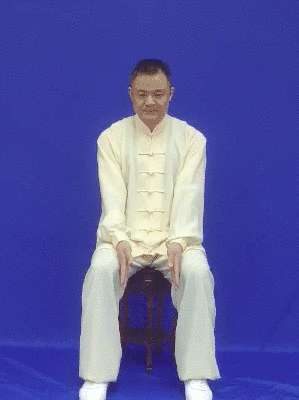
From Hu Xiaofei, Qianlong Yangsheng Shu (The Qianlong Emperor’s Methods of Cultivating Life).
Preparation: sit upright on a square stool, feet apart at shoulder width, arms on the inner sides of the thighs, palms facing each other.
- On the inhalation, sink the left shoulder and raise the right.
- On the exhalation, sink the right shoulder and raise the left.
- Same as the first movement.
- Same as the second.
- Same as the first.
- Same as the second.
- Same as the first.
- On the exhalation, restore both palms to the legs, Zhongchong (translator’s note: a point at the tip of the middle finger) on Heding (translator’s note: a point at the top of the kneecap), eyes forward.
Key points and effects are the same as for the standing form. While sitting, still keep loose and quiet; steady the hips and knees; sink the shoulders and send them forward.
Jade Dragon Spits the Pearl
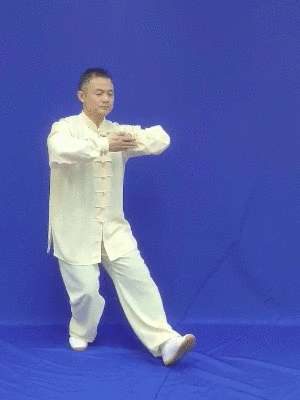
From Hu Xiaofei, Taiji Wuxing Yangsheng Gong (Taiji Five-Phase Practice for Cultivating Life).
Preparation: stand with feet together.
- On the inhalation, turn the body half left; rotate both arms inward and swing them out to the sides.
- On the exhalation, turn the body back, shift weight right, and squat into ding stance. Draw both arms in; stack the wrists of both palms at the side of the abdomen.
- On the inhalation, step the left foot forward into bow stance; swing both arms forward before the body.
- On the exhalation, shift weight back into empty stance; wind the wrists and draw both arms back before the chest.
- On the inhalation, shift weight forward into a rear heel-raised step. Drop both elbows, raise both shoulders, draw both scapulae back, lift the chin, and look up at the sky.
- On the exhalation, shift weight back and restore empty stance. Bring both palms together before the chest; return the head to square.
- On the inhalation, turn the body right; open both palms and prop them at the sides.
- On the exhalation, draw the left foot back; restore both palms at the sides, standing with feet together.
Key points: movements coordinated and continuous; posture upright, centered, and at ease. The emphasis is that while tucking the head and drawing in the nape, the scapulae draw inward through a large range, to stimulate Gaohuangshu. Intention at Gaohuangshu. On exhalation one may lightly utter Si; the original text says this is to benefit the lungs and assist qi, and to prevent colds.
Effects as stated in the original: stimulate Gaohuang and Gaohuangshu, and stimulate and open the lung meridian, used to strengthen the body and prevent colds.
Also to Be Found in Other Practices
“Nine Ghosts Drawing the Sabre” in Yi Jin Jing (Sinew-Transforming Classic), the sound Si in the Six Healing Sounds (Liu Zi Jue), and “Bear Sways,” “Deer Runs,” “Bird Stretches,” and “Turning the Windlass” in the Five Animal Frolics (Wu Qin Xi)—the original text holds that all act on Gaohuang or Gaohuangshu. Practice whenever there is time; one need not wait for a full set’s hour.