


This essay is drawn from published discussion. It cites classical Chinese books, the words of others, or academic argument, and is meant as cultural reading on the traditional cultivation of life. What it says about the body, and about what practice may do, belongs to the sources quoted or to the original speaker. It is not a medical promise or clinical advice from the people who operate this website.
Hu Xiaofei. He composed Yangsheng Zhuji Gong together with Zhang Guangde.
Do Not Seek Only the Short, Flat, and Fast
The Shangshu (Book of Documents) speaks of the Five Blessings: “first, longevity; second, wealth; third, health and peace; fourth, love of virtue; fifth, a completed span of life.” Health is an important one among them; longevity is placed first. The Daoist Laozi took “long life and lasting vision” as the highest aim of cultivating and refining life. Joseph Needham once said that Daoism holds the idea of not dying—something other countries do not have. Here “not dying” means living out the years one ought to enjoy: exhausting the allotted span of heaven.
Hu Xiaofei writes that the incidence and death of modern civilization diseases—hypertension, coronary heart disease, diabetes, cancer, neurasthenia, and the like—keep climbing, and sub-health grows ever more severe. He cites Bosi Data as saying that at that time China’s sub-healthy population had already reached seventy percent, and calls it the great enemy of health today.
In teaching and making television, students and directors often ask at first meeting: Can I learn this practice in a day? I have such-and-such an illness—can practice cure it? Is there one move for neck and shoulder pain? People like the short, flat, and fast; they look only at whether there is feeling right after practice, not at the process; they like only complete sets and neglect laying a foundation; they care only for outer movement and lack inner cultivation. This has to do with the fast pace of modern life and the entry of Western “fast-food culture.” Eager for quick success, one often gains little.
The main function of traditional arts of cultivating life is to regulate body and mind through long enjoyment of the process of practice, together with learning knowledge of cultivation, forming ideas of cultivation, and practicing a more reasonable way of life, so as to prevent illness before it arises. This needs emptiness, quiet, and a settled heart, then using the mind to feel body, heart, and spirit joined as one.
Many concrete problems—whether the hand is swung to the right place, how the breath matches the movement, how to lift the heels and stand steady—Hu Xiaofei holds that more than eighty percent come from an unsteady foundation and methods not mastered. The old saying goes: “Without accumulating steps, one cannot reach a thousand li; without accumulating small streams, one cannot make rivers and seas.” If the foundation is not firm, the earth shakes and the mountains rock. If the body-form is not upright, the movements uncoordinated, the sense of qi not full, the breath irregular, the intention not single, it is hard to enter what Laozi’s Daodejing calls “embracing the bodily soul in one, concentrating qi to attain softness, washing away the mysterious mirror,” and hard to obtain the effects of driving out illness and strengthening the body of which the original text speaks.
For this reason Hu Xiaofei and his teacher Zhang Guangde, creator of Daoyin Yangsheng Gong, together composed Yangsheng Zhuji Gong (Foundation Practice).
What Laying the Foundation Is
Laying the foundation comes from Daoist inner alchemy: it means the preparation and base-building of inner alchemical refinement. When inner practice begins, one must first repair the body and replenish the three treasures of essence, qi, and spirit, until the three treasures are sufficient—like building a house by first laying the groundwork. Chinese medicine also gives this name to the stage of laying a foundation in qigong exercise: through regulating the spirit (gathering the heart, stopping thought, inner vision, guarding the apertures), regulating qi (adjusting inner and outer breath, opening the eight extraordinary vessels), and regulating essence (preserving and replenishing essence), one gradually accumulates until essence is full, qi sufficient, and spirit flourishing. Only when the foundation is solid does one speak of refining essence into qi, refining qi into spirit, and refining spirit back into emptiness.
This standing practice draws on the refining ideas of inner alchemy and the practice means of Chinese medicine; its aim is to lay a solid foundation and raise skill, not to pursue opening the heavenly eye, stimulating paranormal powers, or other unrealistic marvels. On the basis of decades of practice, the two professors drew strengths from methods such as Medical Quiet Practice, Quiet Sitting for Cultivation and Immortality, Quieting the Spirit and Refining Intention to Regulate the Heart, and Nourishing Blood, Replenishing Qi, and Benefiting Longevity, and after repeated practice composed this set.
It takes an upright, centered, at-ease posture and soft, slow, round, even movement as base; leisurely, even, fine, slow breathing as motive force; and intention held as if faintly present as core—seeking intention, qi, and form joined as one. What is to be cultivated is three things:
- Shape a reasonable, relaxed, natural body-form, and coordinated, round, even, soft, slow movement; establish a motor pattern of upper and lower following each other, inner and outer uniting.
- Master natural, fluent, leisurely, even, fine, slow breathing; raise the ability to regulate the rhythm of breath; learn to use consciousness.
- Form the artistic conception “still as an autumn moonlit night, moving like willows with the wind”; strengthen the sense of qi; increase recognition of and sensitivity to qi; and lay a foundation for further practice of various arts of cultivating life and Taiji.
For beginners it is also a standing practice for training abdominal breathing.
On the basis of the ancients’ gathering the heart, stopping thought, inner vision, guarding the apertures, circulating the breath, the celestial circuits, preserving essence, and replenishing essence, the practice arranges links such as regulating the postnatal, replenishing the prenatal, opening and closing to draw qi, broadly gathering heavenly yang, qi pouring through Baihui (translator’s note: a point at the crown of the head), widely taking in earthly yin, qi returning to the Dantian, and intention circulating Ren and Du—lest old-style standing practice be vague in aim, monotonous in form, arid in content, and lest one easily cling to appearance or go astray.
Drawing qi, gathering qi, storing qi, circulating qi, together with concentrating the spirit and regulating the breath, are meant to let a person form, in practice, an upright, centered, at-ease posture; a motor pattern of upper and lower coordination; a sense of qi that is sunk yet full; and a mood as if bathed in spring wind. Effects as stated in the original: purify the mind, relax the spirit, regulate the autonomic nerves, open qi and blood, fortify the center and replenish the yuan. More important still is long laying of the foundation, building firm the base of intention, qi, and form united in the three regulations.
On the surface one speaks of qi; in fact one trains intention. Chan has a line: “Bodhidharma came from the west with not a single word; all relies on the heart-intention to refine practice.” Chinese medicine also says: where intention arrives, qi arrives. When intention reaches the farthest end, qi arrives.
How the Eight Links Join
Below is the composing logic as Hu Xiaofei speaks it: quiet the mind, tend the zang-fu, gather qi, store qi, circulate qi. One may let consciousness follow the course of qi once through the body. These gathering, drawing in, storing, circulating, and nourishing are only means, not ends.
Preparatory Form: Opening Practice with the Three Regulations
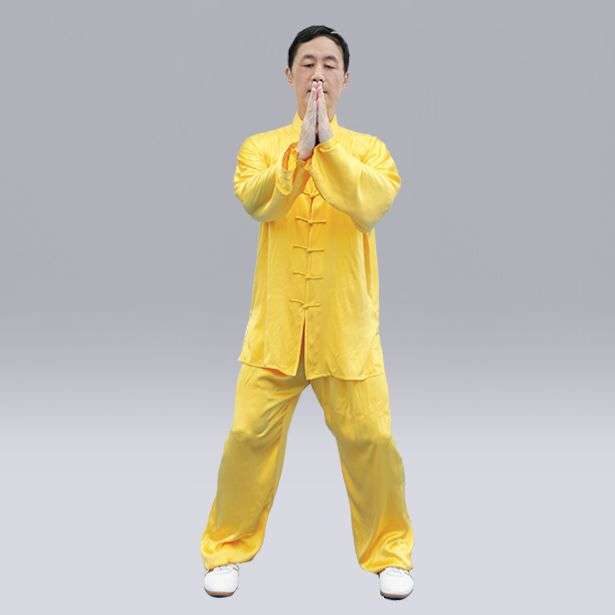
First level the mood and quiet the mind.
Buddhist scripture says that those who can awaken themselves, awaken others, and bring awakening and conduct to completion are all called Buddha. So the preparatory form adopts the posture of bowing to the Buddha, pointing straight at the three regulations joined as one: regulating form, regulating the breath, regulating the spirit—leading a person into the state of washing away the mysterious mirror, bland emptiness, and deep reverence.
Daoyan Qianjin says: “When the mind rests below the navel, that is concentrating the spirit; when qi returns below the navel, that is regulating the breath. When spirit and breath rely on each other, and one guards their clear stillness and naturalness, that is ‘do not forget’; when one follows their clear purity and naturalness, that is ‘do not force.’” This form seeks unity of intention, deep and long breathing, and a body light as a swallow, through intention at the Dantian, abdominal breathing, and an upright, centered body.
First Form: Regulating the Postnatal
Once body and mind are loosened, use intention, qi, and form to regulate the inner organs. The first form holds intention at the Dantian and regulates spleen and stomach.
The old saying goes: “Nourish the Dantian until it is warmly melting—this is the first achievement of refining the true.” The Dantian is where true qi dwells. When the Dantian is warm, it can moisten the zang-fu and the four limbs and hundred bones, improving the root of life and nature, the source of vitality, the meeting of yin and yang, the gate of breath, and the place where water and fire join. This form is described as both replenishing the prenatal kidneys and regulating the postnatal spleen and stomach, especially helping the absorption of postnatal nourishment to moisten the five zang and six fu.
Second Form: Replenishing the Prenatal
Through warming Mingmen (translator’s note: a point on the lower back, under the second lumbar vertebra) and opening Du Mai, replenish the prenatal.
A person must first have a body able to receive replenishment before supplementation can work. When the body is very depleted and one still gobbles ginseng and deer antler, it will cause deficient fire to flare upward and yang qi to desert within. Gathering qi is the same principle: if body and mind within and without have not yet been regulated, one cannot—and cannot possibly—at once gather large amounts of the essence of heaven and earth to replenish inner qi. So Foundation Practice first arranges replenishing kidney qi and regulating spleen and stomach, seizing the prenatal and postnatal roots, regulating the qi and blood of the zang-fu, then entering the later gathering, drawing in, storing, and circulating.
Third Form: Guiding Qi to Laogong (translator’s note: a point in the centre of the palm)
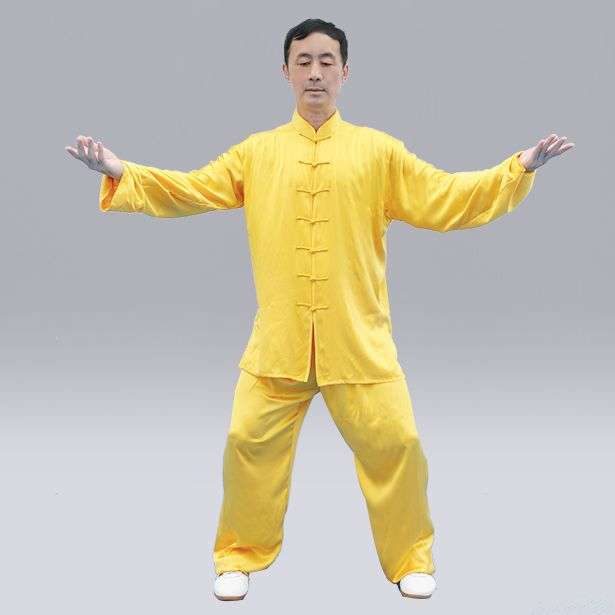
After the five zang have been regulated, begin gathering qi—first gathering heavenly yang. Laogong is the point of the body most open and most able to receive yang qi. Before gathering qi, first make Laogong excited and sensitive, as if drawing back a curtain. Open and close both palms to draw qi, intention at Laogong, until there appears sourness, fullness, numbness, and warmth.
Fourth Form: Broadly Gathering Heavenly Yang
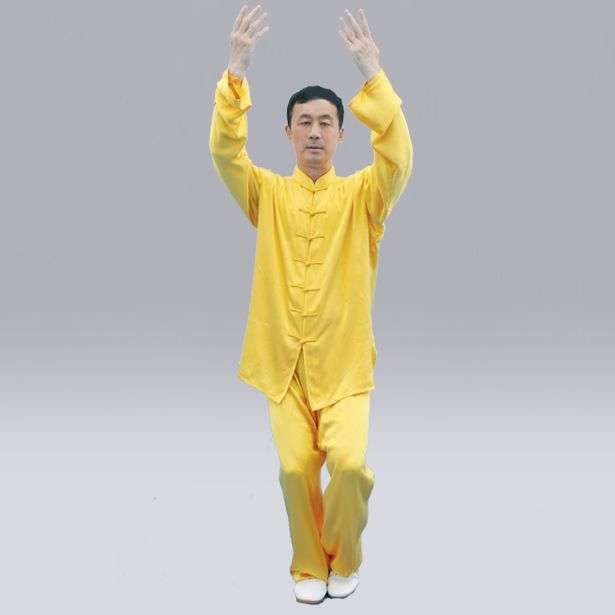
Once Laogong is sensitive, rotate both arms outward, raise them before the sides of the body, and gather the qi of heavenly yang. Hold intention at Laogong, gather heavenly yang; the original text says this form has the efficacy of fortifying the center and replenishing the yuan. The skin is an auxiliary organ of respiration; the previous form stimulates Laogong open, and only then does this form borrow it to gather.
Fifth Form: Qi Pouring Through Baihui
After heavenly yang has been gathered, by the balance of yin and yang one must also gather earthly yin, seeking yin and yang secret and at peace. Before widely taking in earthly yin, first use ding-stance standing and rising on the toes to stimulate Yongquan (translator’s note: a point on the sole of the foot) and excite it. At the same time raise both Laogong above the crown, pour heavenly yang into Baihui, then through Ren Mai return it to the Dantian to merge with earthly yin.
Sixth Form: Widely Taking In Earthly Yin
Once Yongquan is excited, use a pressing-down stance and hold intention at Yongquan. Prop both palms up and press them down, widely taking in the qi of earthly yin.
Seventh Form: Qi Returning to the Dantian
The essence of heaven and earth that has been gathered must not run wild in the body. The Dantian is the dwelling of true yuan qi, the root of life and nature, the source of vitality, the meeting of yin and yang, the gate of breath, the place where water and fire join. Only when Dantian qi is abundant can one fortify the center and replenish the yuan, then distribute it through the whole body to moisten the four limbs and hundred bones.
This form, through drawing in qi, circulating qi, and nourishing qi, brings the essence of heaven and earth and the qi and blood of the whole body back into the Dantian, storing and cultivating the true yuan.
Eighth Form: Intention Circulating Ren and Du
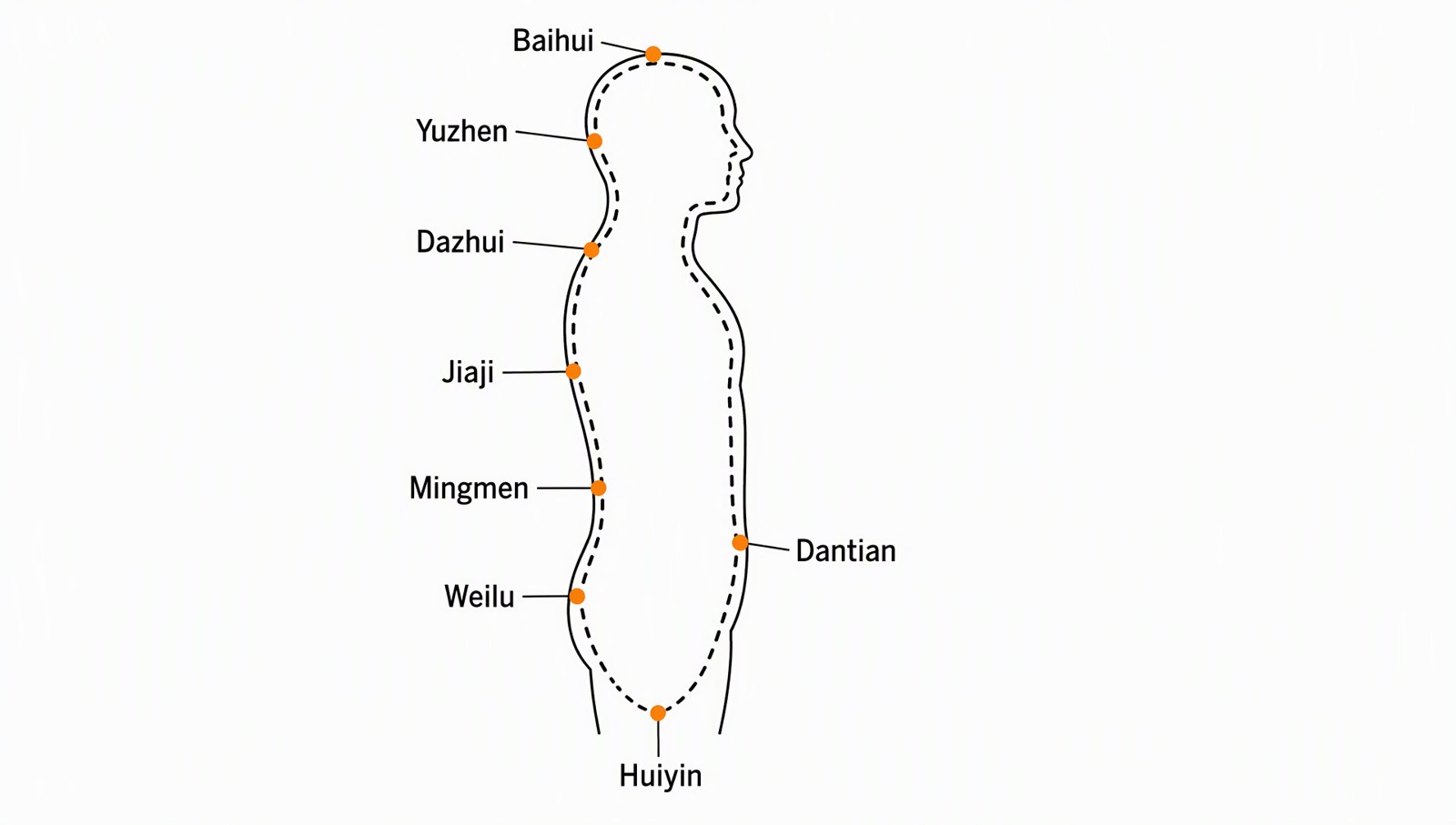
Chinese medicine holds that qi stagnation and blood stasis are the root of a hundred illnesses; qi must not accumulate in blockage. The last form uses conscious guidance to set Dantian qi in motion and distribute it through the whole body.
“Ren Mai commands the six yin meridians; Du Mai oversees the six yang meridians.” “When Ren and Du communicate, the hundred vessels all communicate.” Conveying qi and blood by way of Ren and Du is what the original text holds to be the most convenient method. To circulate intention along Ren and Du and open the hundred vessels, first seize the postnatal and prenatal roots, then gather heavenly yang and earthly yin, store them in the Dantian, and make qi and blood abundant.
Imagine: a stream of heat arises from the Dantian, goes down to Huiyin, passes the three gates of Weilu, Jiaji, and Yuzhen to reach Baihui, then by way of the Magpie Bridge—tongue pressed to the upper palate—returns to the Dantian. Circulate thus for two more circuits.
The original text says that in this way one can open the meridians, regulate yin and yang, strengthen the zang-fu, regulate the spirit, and further open potential, strengthen the body, and prevent illness.
After Practice
Once intention has circulated Ren and Du and driven the flow of qi and blood, generate saliva and send it deeply into the Dantian. Chinese medicine holds that “when upright qi dwells within, pathogen cannot interfere.” The original text cites Chinese and foreign research saying that saliva contains many substances most able to raise the body’s qi; sending the increased saliva into the Dantian is described as able to fortify center qi, replenish yuan qi, and cultivate upright qi.
Finally rub the hands and bathe the face, warming and opening the countenance, so that the bit of beauty after practice may remain.
What Is Trained Is Intention
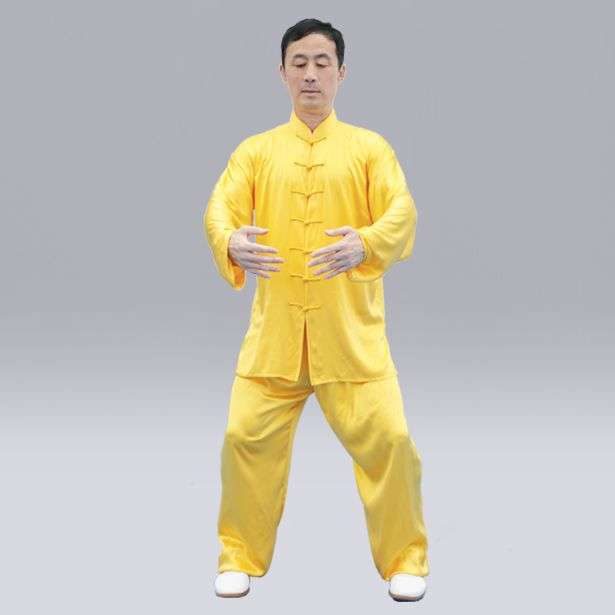
Whether one can gather heavenly yang and earthly yin, how much qi one can draw in and store—Hu Xiaofei says frankly he does not know, and this is not the goal Foundation Practice pursues. What this chain of practice is to reach is: in spirit, bland emptiness; in breath, leisurely, even, fine, and slow; in body-form, upright, centered, and at ease; in movement, coordinated and natural; in the sense of qi, full and substantial—thereby laying firm the basic skill of traditional arts of cultivating life.
It serves the realm of “form and soul embracing one, spirit guarded within, washing away the mysterious mirror.” The original text also holds that it can regulate the central nervous system, lower mental tension, and be used to prevent and treat symptoms of modern civilization diseases such as neurasthenia, insomnia, hypertension, and indigestion.
Training intention is the root. Where intention arrives, qi arrives; where qi arrives, blood moves. Training intention is, in substance, for the sake of training qi.