
This essay is drawn from published discussion. It cites classical Chinese books, the words of others, or academic argument, and is meant as cultural reading on the traditional cultivation of life. What it says about the body, and about what practice may do, belongs to the sources quoted or to the original speaker. It is not a medical promise or clinical advice from the people who operate this website.
Children’s Ba Duan Jin uses stretching the sinews and bones and martial movements that alternate fast and slow, joined with breathing, mental regulation, routines, and children’s songs. The original text says that when children practice it, they may strengthen the body, harmonize body and mind, correct posture, open intelligence, temper the temperament, and form the habit of long-term exercise, and may also meet Chinese medical knowledge and traditional culture. The educational intent of its creation is “to nourish what is upright from the first covering.”
The principal creators are Hu Xiaofei of the Daoyin Yangsheng Center at Beijing Sport University and his graduate students: Fan Gaosheng, Fang Hui, Fang Wenze, Gong Mingjun, Han Xiaoming, Huang Meilian, Leng Chuanqi, Peng Xiangji, Sun Kezhong, Wang Rundong, Yang Shuai, and others. The sixth form is taught by Hu Xiaofei; demonstration by Zhang Liwei.
In this set of manuscripts, all eight forms have children’s songs; only the sixth form has the full counts written out. The counts for the other forms rely mainly on video in the original, and are not supplied here.
Opening Practice with the Three Regulations
Correct the body’s form, correct posture, loosen the whole body, and promote blood circulation; even the breath, gather the thought; prepare for the practice that follows.
First Form Holding Up the Hands to Regulate the Sanjiao
The sanjiao runs through upper, middle, and lower; it regulates the waterways and moves original true qi.
Prop heaven and plant the earth, draw up waist and body; shape the form, strengthen the body, and add spirit.
Second Form Looking Backward to Ease the Five Strains and Seven Injuries
Dazhui (translator’s note: a point just below the seventh cervical vertebra) and Dingchuan lie in neck and shoulder; benefit qi, open yang, and rush to the nine heavens.
Look left and right, cast the eyes afar; afflictions of spirit and form dare not offend.
Third Form Raising One Arm to Regulate the Spleen and Stomach
Spleen and stomach, the postnatal, settle the central plain; they transform water and grain, and blood and qi are complete.
Stand between heaven and earth, prop and press; qi and blood fill, and the body is sound.
Fourth Form Drawing the Bow to Shoot the Vulture
The lungs are the minister and called Huagai; they govern breathing and face the hundred vessels.
Bend the bow and shoot the arrow, practice diligently; heroic air and bearing nurture talent.
Fifth Form Swaying the Head and Tail to Remove Heart Fire
The heart is the sovereign, its place is honored; it rules the five zang and benefits blood and spirit.
Sway the head and tail, blend heart and kidneys; water and fire aid each other, body and mind at peace.
Sixth Form Clenching the Fists and Glaring to Increase Strength
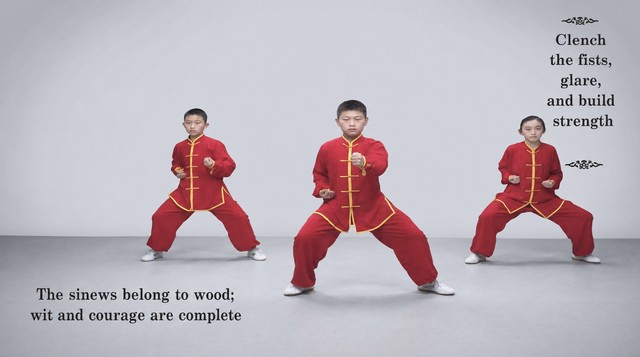
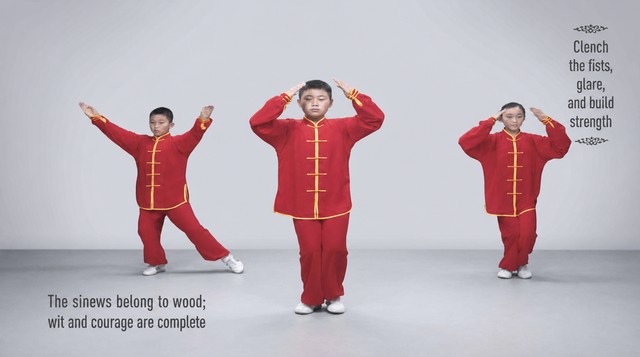
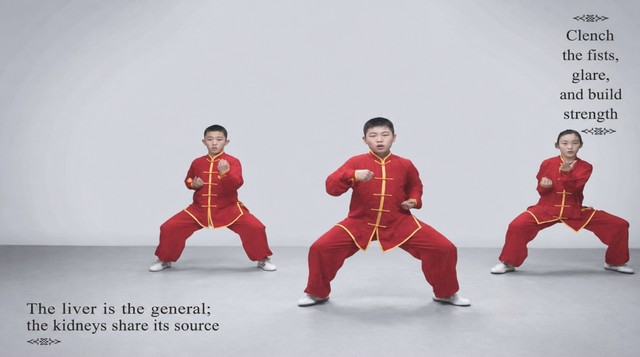
The liver is the general, and shares one source with the kidneys; it governs the sinews and opens wood, wisdom and courage complete.
Glaring, thrusting fists, the roar shakes; the spirit of Yue Fei is passed on forever.
Effects as stated in the original: drain liver fire, soothe the liver and benefit the gallbladder; firm the kidneys and strengthen the waist, raise the strength of upper and lower limbs; cultivate upright qi.
Preparation: continue from the previous form.
First count. Chant “The liver is the general, and shares one source with the kidneys.” On the inhalation, step the left foot out to the left, about three foot-lengths, toes forward. At the same time both arms rotate inward and swing to the sides, then rotate outward and rise to shoulder height, palms up, eyes on the left palm. Then squat into horse stance; with twisting waist and turning the body right, swing the left arm forward before the chest, draw the right arm back, curl the fingers in turn into fists, and hold them at the waist, eyes following the left palm.
Second count. Chant “It governs the sinews and opens wood, wisdom and courage complete.” On the exhalation, horse stance unchanged, hips and knees fixed. With the sound “ha,” twist the waist and follow with the shoulder, thrust the right fist out, palm down, face of the fist forward. At the same time the left palm curls the fingers in turn into a fist and snaps back to the waist, fist-heart up, glaring ahead. Without pause, again with the sound “ha,” twist the waist and follow with the shoulder, thrust the left fist out, draw the right fist back to the waist, glaring ahead.
Third count. Chant “Glaring, thrusting fists, the roar shakes.” On the inhalation, shift weight right; both fists become palms, both arms rotate inward through the sides and swing out, then rotate outward and swing up to shoulder height, palms up, eyes on the right palm. Then bring the left foot together with the right and squat slightly. Both palms join inward before the head, palms down, about ten centimeters from the head, about ten centimeters between the fingers of the two palms, eyes forward.
Fourth count. Chant “The spirit of Yue Fei is passed on forever.” On the exhalation, straighten both legs slowly; both palms press down from before the face to the sides of the body, then curl the fingers in turn into fists and hold them at the waist, eyes forward.
Counts five through eight repeat counts one through four. When finished, both palms drop to the sides, stand with feet together, eyes forward.
Key points: combine stillness and motion, alternate fast and slow, crisp and clean. When thrusting the fist, glare with round eyes, toes grip the ground, force reaches the face of the fist, and the thrust and the “ha” sound are simultaneous. Before fist becomes palm, Zhongchong (translator’s note: a point at the tip of the middle finger) must tap Laogong (translator’s note: the centre of the palm) in an instant. In horse stance, fix hips and knees; lead the waist with the rear elbow, fully twist the waist and follow with the shoulder. Do not drag or trail. When thrusting, do not shrug the shoulders or lift the elbows; do not loosen the waist or kneel at the knees.
Seventh Form Reaching the Feet to Firm the Kidneys and Waist
The kidneys are the prenatal, the army that guards the frontiers; they govern the bones, produce marrow, and store essence and hun.
Bend and reach the feet, squat and rise often; strengthen the bones, increase force, and keep wisdom fresh.
Eighth Form Seven Bounces Behind to Quiet a Hundred Ills
Meridians everywhere join body and mind; they carry qi and blood to moisten form and spirit.
Raise the heels and bounce the feet, regulate the hundred vessels; roots deep, leaves full, youth renewed.
Closing Form
Loosen body and mind, even the breath, calm the mood.