

This essay is drawn from published discussion. It cites classical Chinese books, the words of others, or academic argument, and is meant as cultural reading on the traditional cultivation of life. What it says about the body, and about what practice may do, belongs to the sources quoted or to the original speaker. It is not a medical promise or clinical advice from the people who operate this website.
What follows is arranged from Qu Siyuan’s report, originally carried by “Gaotie Shuyuan” (High-Speed Rail Academy). What health means, what counts as successful health management, and those ten suggestions have already been written separately as “Health Is More Than a Body Free of Illness,” and are not pasted here again. All three lectures spoke of health management and led everyone through workplace relaxation. The report answered the call of certain health plans of the time; here only that sentence is kept.
September: Dispatch Staff
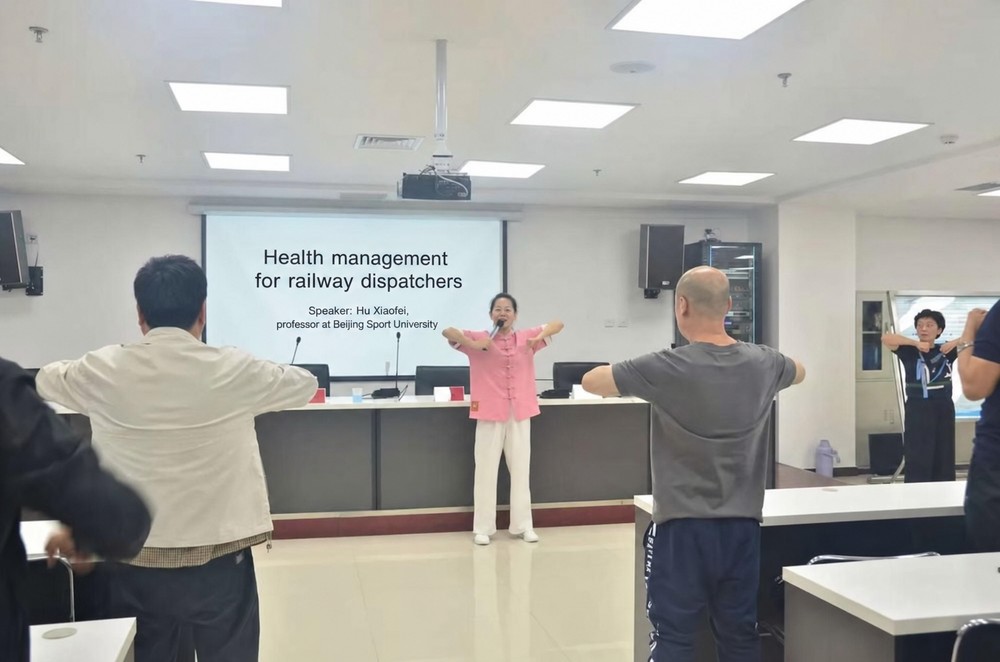
In mid-September Hu Xiaofei lectured on health management for railway dispatch staff and popularized sport and fitness. Dispatch work means long hours, heavy labor intensity, long sitting and long staring, and mental strain. Along the line of “treating the not-yet-ill,” he spoke of exercise, breathing, and mood together, and said each person is the first responsible party for their own health. Long overload causes local overstrain, and the function of the zang-fu also declines; especial care should be given to the liver and spleen.
He suggested that in brief pauses during the shift, for parts prone to strain, one do “extending the limbs and reverse-order regulation”: gently draw apart, in the opposite direction, postures held fixed for a long time. At rest, do regular whole-body practice, seeking to avoid harm and prevent injury.
In the questionnaire after the lecture, one worker wrote: this lecture eased the pressure of work; the gymnastics for relieving pressure loosened body and mind, and would later help dispatch staff ease physical and mental fatigue. Another wrote: today’s exercise routine can raise attention, and is beneficial for ensuring dispatch safety.
27 November: Shanghai Railway Bureau Offices
The Party Committee and Trade Union of the organs directly under the Shanghai Railway Bureau Group Company held the twenty-seventh “Organs Lecture Hall,” inviting Hu Xiaofei to give “Health Management for Railway Workers.” He first led everyone through Ba Duan Jin (Eight Pieces of Brocade), then spoke of what health is, the wisdom and instances of health management, and several fitness tips suited to office work. Yin Biwen, chair of the trade union of the organs directly under the bureau, spoke next: shift the idea from “treating already-ill” to “treating the not-yet-ill,” and encouraged joining interest groups such as office Taijiquan. About one hundred members from the various office departments were present.
28 December: Hangzhou Train-Operations System
That afternoon he went from Shanghai Hongqiao to Hangzhou and lectured for train-operations staff. Grassroots work is often repetitive mechanical labor; many trades work day and night shifts year-round; some line work is dangerous, and there are no fixed holidays. The report holds that workers’ health affects transport safety and work efficiency; adding health management to this safety training drew a warm response from the trainees. About ninety people attended in Hangzhou.
The report writes these three occasions as an exploration: starting from “treating the not-yet-ill,” joining the views of sport and of medicine, and offering railway workers suggestions for health management that can be put into practice.